Sunday, October 15, 2017

1/144 Hawker Hunter T.7 ‘Two-seat Trainer’ - Mark I


MKM14481 1/144 Hawker Hunter T.7 ‘Two-seat Trainer’ (RAF, RNethAF, Danish AF)

One ex-Revell kit and a new frame with different fuselage halves and small parts, also a new injection-moulded canopy is included. One model can be built out of each box.

The Hawker Hunter was a British jet fighter developed during the late 1940s and its prototype, the P.1067, was flown in July 1951. Succeeding first-generation jet fighters such as the Meteor and Venom, the first Hunters were introduced to RAF service in 1954.

The Hunter T Mk.7 was a two-seat trainer variant built for the RAF. It had the single seat nose replaced by a side-by-side seating section. Originally based on the F Mk.4 fighter, six aeroplanes were rebuilt and 65 were built new (incl. 10 a/c for the Royal Navy as T Mk.8s); the first T Mk.7s entered service in 1958. The Netherlands bought 20 T Mk.7 aircraft, half of which were later sold to other countries, including Denmark.

It was a two-seat swept wing all-metal monoplane aircraft powered by a R-R Avon turbojet. It featured two wing-root intakes, single jet pipe, upward-opened canopy, ejection seats and tail-mounted brake parachute. The on-board armament of the two-seat Hunter was reduced to one (or two) Aden cannon semi-buried in the fuselage undersurface, while up to four drop tanks could be carried beneath the wings.

The Hunter was one of the RAF’s mainstays from the mid-1950s through the sixties. It became a popular machine in foreign service, being exported to many countries worldwide. Two-seat variants remained in use for training and secondary roles with the RAF and the Royal Navy until the early 1990s.

Colour schemes included in the kit:
1) Hawker Hunter T Mk.7, XL568, Black X, No.74 Sq., RAF, Coltishall Air Base, Norfolk, U.K., September 1959
2) Hawker Hunter T Mk.7, XL566, White TW, No.1417 (FR) Flight, RAF, Khormaksar Air Base, Aden Protectorate (State of Aden), 1965
3) Hawker Hunter T Mk.7, N-303, White 63, No.325 Sq., Royal Netherlands Air Force (Koninklijke Luchtmacht, KLu), Soesterberg Air Base, the Netherlands, 1964
4) Hawker Hunter T Mk.7, ET-273 (ex-Dutch N-302), Black 273, No.724 Sq. (Esk 724), Royal Danish Air Force (Kongelige Danske Flyvevåbnet), Skrydstrup Air Base, Denmark, 1974

This injection-moulded kit contains 34 parts (moulded in grey plastic) and one clear part (the cockpit canopy). A comprehensive instruction leaflet and a decal sheet are included.

https://www.hannants.co.uk/product/MKM14481

Price £14.99


1/144 Hawker Hunter T.8B/T.8C ‘Naval Trainer’ - Mark I


MKM14482 1/144 Hawker Hunter T.8B/T.8C ‘Naval Trainer’ (RN, RAF)

One ex-Revell kit and a new frame with different fuselage halves and small parts, also a new injection-moulded canopy is included. One model can be built out of each box.

The Hawker Hunter was a British jet fighter developed during the late 1940s and its prototype, the P.1067, was flown in July 1951. Succeeding first-generation jet fighters such as the Meteor and Venom, the first Hunters were introduced into service in the mid-1950s.

For pilot training a two-seat variant was developed for the RAF, designated the T Mk.7 and flying in late 1957. The Hunter T Mk.8 was its Royal Navy equivalent but fitted with an arrestor hook for use on airfields. Ten were new builds and 18 conversions from F Mk.4s, all made in the period 1958-59. The T Mk.8B and T Mk.8Cs followed (conversions from F Mk.4 and T Mk.8s), with improved navigational equipment, used for Buccaneer conversion training (both by the RN and RAF), while a handful of aircraft were further upgraded to T Mk.8Ms to train Sea Harrier pilots.

The Hunter T Mk.8 was a two-seat swept wing all-metal monoplane aircraft powered by a R-R Avon turbojet. The pilots were seated side-by-side in the nose section. It featured two wing-root intakes, single jet pipe, upward-opened canopy, ejection seats and tail-mounted brake parachute. The on-board armament of the two-seat Hunter Mark 8 was reduced to one Aden cannon semi-buried in the starboard fuselage undersurface, while up to four drop tanks could be carried beneath the wings.

The Hunter was one of the RAF’s mainstays from the mid-1950s through the sixties. It became a popular machine in foreign service, being exported to many countries worldwide. Two-seat variants remained in use for training and secondary roles with the RAF and the Royal Navy until the early 1990s.

Colour schemes included in the kit:
1) Hawker Hunter T Mk.8B, XF991/LM, Black 688, No.764 NAS, RN, RNAS Lossiemouth (HMS Fulmar), Moray, U.K., July 1969-July 1972
2) Hawker Hunter T Mk.8B, XF995, No.237 OCU (Operational Conversion Unit), RAF,
Honington Air Base, Suffolk, U.K., 1980
3) Hawker Hunter T Mk.8C, XF994/VL, Black 873, Fleet Requirements and Air Direction Unit (FRADU), RN, RNAS Yeovilton (HMS Heron), Somerset, U.K., May 1987-May 1995
4) Hawker Hunter T Mk.8C, XL580, White VL, ‘Admiral’s Barge’ (Flag Officer Flying Training personal aircraft), RN, RNAS Yeovilton (HMS Heron), Somerset, U.K., 1969

This injection-moulded kit contains 35 parts (moulded in grey plastic) and one clear part (the cockpit canopy). A comprehensive instruction leaflet and a decal sheet are included.

https://www.hannants.co.uk/product/MKM14482

Price: £14.99


1/144 Resin and Vac-Form Upgrades - Sun Detail


1/144 Resin and Vac-Form Upgrades - Sun Detail

Aero L-39 (designed to be used with Attack and MARK I Models kits))[L-39ZO/ZA/ART L-39C / L-39ZO L-39V L39ZA/L-139 L-39MS/L-59 'Super Albatros']
Control surfaces £5.80
Avionics bay £5.80
Cockpit £5.80

Messerschmitt Bf-109 (designed to be used with MARK I Models kits)[[Bf-109G-1/Bf-109G-2 Bf-109G-4 Bf-109G-5/Bf-109G-6]
Engine £5.80
Cockpit £5.80
Canopy (closed, 1 pcs) £3.99

Messerschmitt Me-262A/Me-262B (designed to be used with Eduard kits)
Nose Guns  £5.80

Avia/Letov C-2/Arado Ar-96B (designed to be used with MARK I Models kits)
Engine £5.80
Cockpit £5.80
Control surfaces £5.80
Canopy (open/closed, 2 pcs) £3.99

Mikoyan MiG-21 (designed to be used with Eduard kits)[MiG-21SMT MiG-21BIS MiG-21MF]
Flaps, ( £3.99

Curtiss H-75/Mohawk III/P-36 (designed to be used with MARK I Models kits)
Cockpit £TBA
Control surfaces £TBA

Available: Hannants and other stockists


Friday, October 06, 2017

1/144 Messerschmitt Bf 109 E-3/E-4 Sets - Armory


#14303 1/144 Bf 109 E-3/E-4 Set#1 WWII in the Beginning - Armory
#14304 1/144 Bf 109 E-3/E-4 Set#2 Battle of Britain Aces - Armory

Two kits in each set, two sets to be released with multiple decal options!

The Battle of Britain set appears to have decal options for a number of squadrons/aces (II/JG51,
JG52,II/JG3,JG26, JG54 - Adolf Galland etc...) http://www.luftwaffe.cz/bob.html

Release: "Coming Soon"

Source:
https://www.facebook.com/armorymodelsgroup/photos/pb.1402311443326596.-2207520000.1507253608./2402864559937941/?type=3&theater

https://www.facebook.com/armorymodelsgroup/photos/pb.1402311443326596.-2207520000.1507253608./2402864286604635/?type=3&theater

Monday, October 02, 2017

1/144 Messerschmitt Me-323 D-1 "Gigant" by Pit-Road


1/144 Messerschmitt Me-323 D-1 "Gigant" by Pit-Road
Pit Road are bringing out an unusual kit, usually the realm of Anigrand (see their Me-321 http://www.anigrand.com/AA4077_Me-321.htm), and of course Matsuo Kasten did the version of this Me-323 (https://kampfgruppe144.blogspot.co.uk/2009/10/1144-me-323-gigant-matsuo-kasten.html).

It will be interesting to see if there is a link up with Great Wall Hobby (GWH) as was the case with the V-bomber Series Releases?

The specification called for the glider to be capable of carrying either an 88 mm gun plus its tractor, or a medium tank. The codename Projekt Warschau ("Project Warsaw") was used, with Junkers being given the codename Warschau-Ost and Messerschmitt Warschau-Süd.

The Me 263 had a framework of steel tubing provided by the Mannesmann company, with wooden spars and a covering of doped fabric. This allowed for quick construction and easy repair when needed and also saved weight. The Me 263 was redesignated the Me 321 and was nicknamed Gigant ("Giant") due to its huge size.

Its nose stood over 6 m (20 ft) high, and was made up of two clamshell doors. The doors could only be opened from the inside, when ramps would be used to allow vehicles to drive in or out. Compared to the Ju 52, the Me 321 offered a load area six times larger, at around 100 m2 (1,100 sq ft), and could accommodate a gross cargo weighing up to 23 t (23 long tons). The cargo space had been designed to replicate the load space of a standard German railway flatcar, allowing any cargo that could travel by rail to fit into an Me 321. Alternatively, if used as a passenger transport, 120-130 fully equipped troops could be accommodated.[2]

The Me 321 was fitted with a jettisonable undercarriage comprising two Bf 109 tailwheels at the front and two Junkers Ju 90 main wheels at the rear and was intended to land on four extendable skids.

The first flight of the prototype Me 321 V1 took place on 25 February 1941, towed into the air by a Ju 90. It was piloted by Messerschmitt test pilot Karl Baur, and carried 3 tonnes (3 tons) of ballast. Baur reported that the controls were heavy and responses sluggish and it was decided to enlarge the cockpit to accommodate a co-pilot and radio operator and dual controls were fitted. Electric servo motors were also fitted to assist in moving the huge trailing edge flaps and further tests caused a braking parachute to also be added.


Sources:
https://en.wikipedia.org/wiki/Messerschmitt_Me_321

http://www.britmodeller.com/forums/index.php?/topic/235027320-1144-messerschmitt-me323d-1-gigant-by-pit-road-test-build/

https://hobbylink.tv/the-latest-scale-model-news-from-the-all-japan-model-hobby-show-2017

1/144 Chance Vought F4U Corsair - by AFV Club


  1/144 Chance Vought F4U Corsair - by AFV Club
Following on from their successful P-40 Series, AFV Club are releasing a F4U Corsair (the spruces show a number of config options with different props etc). Also, the first release of this aircraft since the earlier Bandai or Revell options.

The Vought F4U Corsair is an American fighter aircraft that saw service primarily in World War II and the Korean War. Demand for the aircraft soon overwhelmed Vought's manufacturing capability, resulting in production by Goodyear and Brewster: Goodyear-built Corsairs were designated FG and Brewster-built aircraft F3A. From the first prototype delivery to the U.S. Navy in 1940, to final delivery in 1953 to the French, 12,571 F4U Corsairs were manufactured,[2] in 16 separate models, in the longest production run of any piston-engined fighter in U.S. history (1942–53).[3][4][5]

The Corsair was designed as a carrier-based aircraft but its difficult carrier landing performance rendered it unsuitable for Navy use until the carrier landing issues were overcome by the Royal Navy Fleet Air Arm. The Corsair thus came to and retained prominence in its area of greatest deployment: land based use by the U.S. Marines.[6] The role of the dominant U.S. carrier based fighter in the second part of the war was thus filled by the Grumman F6F Hellcat, powered by the same Double Wasp engine first flown on the Corsair's first prototype in 1940.[7] The Corsair served to a lesser degree in the U.S. Navy. In addition to its use by the U.S. and British, the Corsair was also used by the Royal New Zealand Air Force, the French Naval Aviation and other, smaller, air forces until the 1960s. Some Japanese pilots regarded it as the most formidable American fighter of World War II,[8] and the U.S. Navy counted an 11:1 kill ratio with the F4U Corsair.[9]

After the carrier landing issues had been tackled, it quickly became the most capable carrier-based fighter-bomber of World War II.[10] The Corsair served almost exclusively as a fighter-bomber throughout the Korean War and during the French colonial wars in Indochina and Algeria.[11]

Sources:
https://en.wikipedia.org/wiki/Vought_F4U_Corsair

http://www.britmodeller.com/forums/index.php?/topic/235027318-1144-chance-vought-f4u-corsair-by-afv-club-spruestest-build/

https://www.facebook.com/media/set/?set=a.1512888545423326.1073741955.236926266352900&type=3

https://www.facebook.com/pg/MeritIntlLtd/photos/?tab=album&album_id=117819558309628

https://www.youtube.com/watch?time_continue=233&v=8BQ8UD2e5qA

https://www.facebook.com/AFVCLUB.TW/

1/144 SH-3A Sikorsky Sea King - AFV Club


1/144 SH-3A Sikorsky Sea King - AFV Club
Following on from the success of the AFV Club P40 series, further releases are on their way.

The Sikorsky SH-3 Sea King is a twin-engine medium-sized amphibious rotorcraft. Many of the features on board the Sea King represented a considerable advancement over preceding helicopters. In addition to being fully amphibious and capable of operating under all weather conditions, it holds the distinction of being the first operational American helicopter to be able to simultaneously hunt and destroy submarines.[6] Its twin-turboshaft powerplant layout gave the SH-3 a higher payload and greater reliability than previous anti-submarine helicopters.[5] In the event of a single engine failing, the Sea King could continue flying on a single engine.

Several Sea Kings, operated by the United States Marine Corps's HMX-1 unit, are used as the official helicopters of the President of the United States, for which the call sign 'Marine One' would be used.

The Sea King has also proved to be popular on the export market with foreign military customers, and has also been sold to civil operators as well. As of 2015, many examples of the type remain in service in nations around the world. The Sea King has been built under license by Agusta in Italy, Mitsubishi in Japan, and by Westland in the United Kingdom as the Westland Sea King

Sources:
https://en.wikipedia.org/wiki/Sikorsky_SH-3_Sea_King

http://www.britmodeller.com/forums/index.php?/topic/235027347-1144-sikorky-sh-3a-sea-king-by-afv-club-3d-rendersspruestest-build-release-in-2017/

https://www.facebook.com/AFVCLUB.TW/photos/a.1512888545423326.1073741955.236926266352900/1512888992089948/?type=3&theater

https://www.facebook.com/pg/MeritIntlLtd/photos/?tab=album&album_id=117819558309628

https://www.facebook.com/AFVCLUB.TW/

Wednesday, August 30, 2017

Eduard E-day show 23 Sept 2017


Eduard E-day show 23 Sept 2017

http://www.eday.cz/en

Getting a ticket now has at least two advantages
- avoid the treasure queue and get the priority entry for the event
- get the ticket model now!

What the ticket model will be, we have not been dragging on for some time now. The brand new 2-digit UTI MiG-15 in scale 1/144.

https://www.eduard.com/store/eduard/address-for-dospel-personal-day-2017-uti-mig-15-1-144.html 

For technical reasons, the ticket is only available to customers From the Czech Republic and Slovakia.

For those of you outside the Czech Republic and Slovakia,you an expect to see a boxed version of this kit for retail sale circa Q4'2017 or Q1'2018.

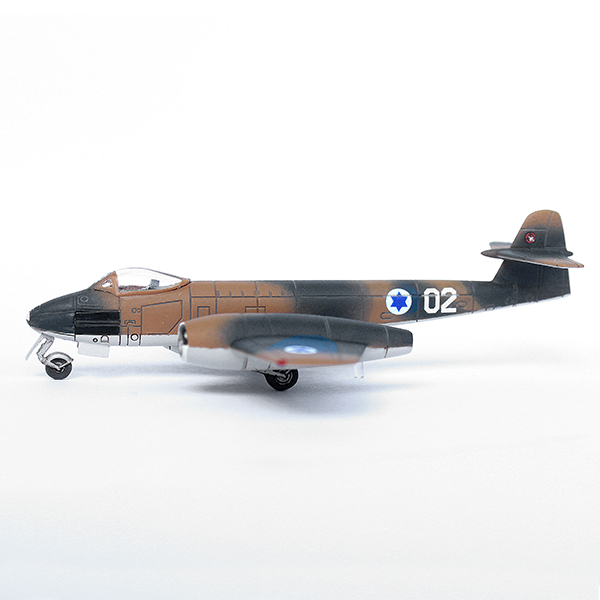
1/144 Gloster METEOR F Mk.8 - Miniwings


1/144 Gloster METEOR F Mk.8 - Miniwings
The Gloster Meteor was the first British jet fighter and the Allies' only jet aircraft to achieve combat operations during the Second World War. The Meteor's development was heavily reliant on its ground-breaking turbojet engines, pioneered by Sir Frank Whittle and his company, Power Jets Ltd. Development of the aircraft began in 1940, although work on the engines had been under way since 1936. The Meteor first flew in 1943 and commenced operations on 27 July 1944 with No. 616 Squadron RAF. Nicknamed the "Meatbox", the Meteor was not a sophisticated aircraft in its aerodynamics, but proved to be a successful combat fighter. Gloster's 1946 civil Meteor F.4 demonstrator G-AIDC was the first civilian-registered jet aircraft in the world.[1]

Several major variants of the Meteor incorporated technological advances during the 1940s and 1950s. Thousands of Meteors were built to fly with the RAF and other air forces and remained in use for several decades. The Meteor saw limited action in the Second World War. Meteors of the Royal Australian Air Force (RAAF) fought in the Korean War. Several other operators such as Argentina, Egypt and Israel flew Meteors in later regional conflicts. Specialised variants of the Meteor were developed for use in photographic aerial reconnaissance and as night fighters.

https://en.wikipedia.org/wiki/Gloster_Meteor

Description:
14 Resin parts
Clear resin and Vacu Canopy
Canopy Mask

Screen printed decals:
- IAF '02' 117 Tajeset 'Hasilon Harishona' Ramat David, 1960, and
- RAF WK803-V no 56 Squadron RAF Waterbeach 1953

http://www.miniwing.cz/gloster-meteor-tmk8.html

Available : Now

http://kits-shop.com/index.php (with free shipping)

also https://www.hannants.co.uk/product/MINI085

See also available : https://kampfgruppe144.blogspot.co.uk/2017/07/1144-gloster-meteor-tmk7-miniwing.html


Northrop Grumman RQ-4 Global Hawk / EuroHawk - Miniwing


Northrop Grumman RQ-4 Global Hawk / EuroHawk

The Northrop Grumman RQ-4 Global Hawk is an unmanned (UAV) surveillance aircraft. It was initially designed by Ryan Aeronautical (now part of Northrop Grumman), and known as Tier II+ during development. The Global Hawk performs a similar role as the Lockheed U-2. The RQ-4 provides a broad overview and systematic surveillance using high-resolution synthetic aperture radar (SAR) and long-range electro-optical/infrared (EO/IR) sensors with long loiter times over target areas. It can survey as much as 40,000 square miles (100,000 km2) of terrain a day.
https://en.wikipedia.org/wiki/Northrop_Grumman_RQ-4_Global_Hawk


A interesting release from Minwing, produced to the excellent standards in injected plastic and presented in the display pack format.

Don't forget, this has big wings ;-)

Available in a number of version from http://kits-shop.com/miniwing-plastic-1-144.php (free shipping)

Ref. No.: mini309
NORTHROP GRUMMAN RQ-4B / USAF
Unmanned surveillance aircraft

Description:
20 Plastic parts
Decals for one Aircraft
http://www.miniwing.cz/rq-4b-usaf.html

Ref. No.: mini310
NORTHROP GRUMMAN RQ-4E / Luftwaffe
Unmanned surveillance aircraft

Description:
20 Plastic parts
Decals for one Aircraft
http://www.miniwing.cz/rq-4b-nato.html

Ref. No.: mini312
NORTHROP GRUMMAN RQ-4 / NASA
Unmanned surveillance aircraft

Description:
20 Plastic parts
Decals for one Aircraft
http://www.miniwing.cz/rq-4-nasa.html


Friday, August 04, 2017

1/144 Lockheed C-5B Galaxy - Roden

1/144 North American 'Harvard' Trainer - Miniwing


1/144 North American 'Harvard' Trainer - Miniwing
Miniwing have repackaged a Valom plastic injection kit of the T-6 Texan Kits, with alternate propeller and decals to product a New Zealand Air Force Trainer.

A great little kit with high production quality.

This kit is presented in the new style display packaging.

https://en.wikipedia.org/wiki/North_American_T-6_Texan

http://www.miniwing.cz/harvard-nzaf.html

Available now: http://kits-shop.com/miniwing-plastic-1-144.php  (free shipping)


Saturday, July 15, 2017

1/144 Yakovlev UT-2 / UT-2M (2 in 1 Box) - Mikro-Mir (Mikr-Mir)


1/144 Yakovlev UT-2 (2 in 1 Box) - Mikro-Mir (Mikr-Mir)

The Yakovlev UT-2 (NATO reporting name "Mink") was a single-engine tandem two-seat low-wing monoplane that was the standard Soviet trainer during the Great Patriotic War. It was used by the Soviet Air Force from 1937 until replaced by the Yakovlev Yak-18 during the 1950s.
The preceding U-2 (Po-2) biplane was no longer a suitable trainer for the faster modern aircraft entering service, and to fill the role, the UT-2 was designed as a trainer.

The new aircraft was designed by Alexander Sergeevich Yakovlev's team at OKB-115. Originally designated AIR-10, it was based upon the AIR-9, but it was simpler, with tandem open cockpits, also omitting slats and flaps. It first flew on 11 July 1935. The AIR-10 won the competition in 1935 and, after minor changes, was accepted as the standard Soviet Air Force trainer.

The wood-and-metal mixed construction of the AIR-10 was simplified to use only wood to facilitate production, and the AIR-10s 120 hp Renault inline engine was replaced with the 112 kW (150 hp) Shvetsov M-11E radial on the prototype, and the 82 kW (110 hp) M-11Gs in early production aircraft. Serial production started in September 1937. The Soviet VVS (Air Force) assigned the aircraft the designation UT-2 (uchebno-trenirovochnyi, trainer).

The UT-2 was not easy to fly and easily entered into spins. The UT-2 model 1940 featured a lengthened forward fuselage, and a change to the 93 kW (125 hp) M-11D radial to attempt to rectify the problem. Despite improvements, the handling and flight characteristics remained challenging.
To further improve handling and stability, the new UT-2M (modernized) variant was developed in 1941 and it replaced the original UT-2 in production. The wing planform was redesigned, with a swept leading edge and a straight trailing edge, and the vertical stabilizer was enlarged.

7,243 UT-2 of all types were produced in five factories between 1937 and 1946. In the 1950s, the UT-2 was replaced by the Yak-18 primary trainer and the Yak-11 advanced trainer.

Before and after World War II the UT-2 was used by civilian organizations, and after the war, UT-2s were also operated by the Polish and Hungarian Air Forces.

http://www.mikro-mir.com/en/300.html

http://www.mikro-mir.com/images/phocagallery/Avia/avia-144/ut2/instr.pdf

https://en.wikipedia.org/wiki/Yakovlev_UT-2


Estimated Release: August 2017