Showing posts with label Avro. Show all posts

Thursday, November 23, 2023

1/144 Avro Shackleton MR.3 'The Growler' by CMR


1/144 Avro Shackleton MR.3 'The Growler' by CMR


Ref. No.: CMR144-001
999,- KČ 899,99 KČ  (35,41 €)


Avro Shackleton MR.3 'The Growler'. 

This full resin kit contains 56 parts, 10 hardened black resin parts (undercarriage), 9 clear resin parts (canopy and fuselage windows) and a comprehensive decal sheet (see below)

The model will be available in two weeks, it is currently available with a 10% Pre-Order discount Pre-Order at: www.eshop.miniwing.cz

https://www.eshop.miniwing.cz/category/mark-i-models/cmr-1-144/avro-shackleton-mr-3-the-growler/


The Avro Shackleton was a British long-range aircraft developed during the late 1940s from the Lincoln bomber. It was primarily used in the ASW and MPA roles, but later it was also deployed as a SAR and AEW platform. The first prototype flew in March 1949 and ensuing production aircraft were designated the MR.1. The MR.2 was an improved version, featuring numerous refinements.

The Type 716 Shackleton MR.3, first flying in September 1955, was another redesign of the airframe, with a tricycle undercarriage replacing the original tailwheel configuration and featuring increased fuselage and new wings with tip tanks. It was a mid-wing monoplane of an all-metal stressed-skin construction, powered by four R-R Griffons with contra-rotating propellers. The aircraft underwent several phased modifications which included the internal changes, ECM equipment and later the addition of two turbojets for assisted take-off. The weapons capability was upgraded, which included bombs, torpedoes, mines or depth-charges up to 10,000 lb/4,536 kg; the aircraft was fitted with two cannons in the nose and another two 20 mm guns in the dorsal turret.

The MR.3 entered service with the RAF in August 1957. The RAF ordered 52 aircraft but following the 1956 Defence Review the number was reduced to 34 aircraft. The last RAF Shackletons were retired in 1991. This type was also operated by the South African Air Force, which received eight aircraft and used them between 1957 and 1984.

https://www.4pluspublications.com/en/produkt/cmr144-001-avro-shackleton-mr-3-the-growler/

Mark I Decals included:

1) Avro Shackleton MR.3, WR975/203-F, No.203 Sq., RAF, Ballykelly Air Base, County Londonderry, Northern Ireland, U.K., 1960

2) Avro Shackleton MR.3, WR987/201-R, No.201 Sq., RAF, St. Mawgan Air Base, Cornwall, U.K., 1958

3) Avro Shackleton MR.3 (Phase II), XF730/120-B, No.120 Sq., RAF, Kinloss Air Base, Moray, Scotland, U.K., 1965

4) Avro Shackleton MR.3, 1716/J, No.35 Sq., SAAF, Air Force Base Ysterplaat, Cape Town, South Africa, 1957

5) Avro Shackleton MR.3 (Phase II), 1722/P, No.35 Sq., SAAF, Air Force Base Ysterplaat, Cape Town, South Africa, the 1960s

6) Avro Shackleton MR.3 (Phase II), 1717/O, No.35 Sq., SAAF, Air Force Base Ysterplaat, Cape Town, South Africa, the 1960s


Instructions: http://www.4pluspublications.com/wp-content/uploads/2023/11/CMR144-001-Avro-Shackleton-MR.3-The-Growler_instr-web.pdf


This is a reissue of the 2005 kit: https://www.kampfgruppe144.com/phpBB3/viewtopic.php?t=3574


Thursday, May 05, 2022

1/144 Avro Lincoln by Welsh Models


1/144 Avro Lincoln by Welsh Models

Here are the resin and metal constitute parts for the forthcoming Avro Type 694 Lincoln WWII heavy bomber Welsh Models intend to release in 1:144th scale .

Release Date: hopefully sometime before June 2022. 

Its made of both resin and metal parts as can be seen along with vac formed clear canopies. The flight deck is fully visible and detailed and the kit allows both Type 1, 2 and 31 versions to be made with two differing noses. The guns along with ammunition racks, seats etc are visible. 

The props and spinners are also made to allow for differing blade feathering. 

Both the RAF, RAAF and Argentine AF used these bombers. It was the last Piston engine bomber used by the RAF. 

www.welshmodels.co.uk

https://www.facebook.com/Welshmodels-148316871912810/

Saturday, October 30, 2021

1/144 V-Bombers in Anti Flash white - CTA Decals


1/144 V-Bombers in Anti Flash white - CTA Decals

UPD: Decal was reborn - now this is silkscreen print. And available for orders!

Well, after all, I roll out new decal. This for V-Bombers fans. Almost all 1/144 kits of Valiant, Vulcan, Victor were released without Anti-flash markings. But now, this problem solved.


Decal include next markings:

Vickers Valiant B(K)Mk.1 XD818, No.49 Squadron. Operation Grapple. First drop Hydrogen Bomb. Malden Island, South Pacific, 15 May 1957.

Vickers Valiant B.1 WZ401, No.207 Squadron. RAF Marham, flown by W/Cdr A D Dick, AFC. November 1963.

Avro Vulcan B.2 XH562, No.35 Squadron. RAF, 1962.

Avro Vulcan B.2 XM570, No.27 Squadron. RAF Scampton, 1963.

Handley Page Victor B.Mk.2 XL158, No.139 Squadron. RAF Wittering, early 1960s.

Handley Page Victor B.Mk.2 XM715, No.100 Squadron. RAF Wittering, April 1963.


Ref:  CTA-002

Available direct (or usual stockists) = $16


https://ctamodels.com/v-bombers-in-anti-flash-white?s=09


Saturday, September 01, 2018

1/144 Avro Vulcan B.2 with Blue Steel Missile - Pit-Road


1/144  Avro Vulcan B.2 with Blue Steel - Pit-Road

A reissue of the Pit-Road Avro Vulcan with  additional parts:

· New parts:
    - nose tip,
    - vertical tail wing upper end,
    - Blue Steel 'air-to-ground' nuclear stand-off missile

· decal:
     - The Famous 617 Squadron ('Dambusters'), Based at  Scampton Air Force Base 1962, and
     -  1x other scheme  (it should be for RAF unit, 4 JSTU - to be confirmed?)

· 1 display unit with display stand

Est shipping: November 2018
Est price: 3,900 yen / £25GBP

Source(s):
http://pit-road.jp/?p=18384
https://hlj.com/product/PITSN-22/Air

So the dilemma here would be - do you grab this on release from Japan, or wait and see if Great Wall Hobbies(GWH) release a cheaper version for sale outside of Japan?

The Avro Vulcan (later Hawker Siddeley Vulcan[2] from July 1963)[3] is a jet-powered tailless delta wing high-altitude strategic bomber, which was operated by the Royal Air Force (RAF) from 1956 until 1984. Aircraft manufacturer A.V. Roe and Company (Avro) designed the Vulcan in response to Specification B.35/46. Of the three V bombers produced, the Vulcan was considered the most technically advanced and hence the riskiest option. Several scale aircraft, designated Avro 707, were produced to test and refine the delta wing design principles.

The Vulcan B.1 was first delivered to the RAF in 1956; deliveries of the improved Vulcan B.2 started in 1960. The B.2 featured more powerful engines, a larger wing, an improved electrical system and electronic countermeasures (ECM); many were modified to accept the Blue Steel missile. As a part of the V-force, the Vulcan was the backbone of the United Kingdom's airborne nuclear deterrent during much of the Cold War. Although the Vulcan was typically armed with nuclear weapons, it was capable of conventional bombing missions, a capability which was used in Operation Black Buck during the Falklands War between the United Kingdom and Argentina in 1982.

The Vulcan had no defensive weaponry, initially relying upon high-speed high-altitude flight to evade interception. Electronic countermeasures were employed by the B.1 (designated B.1A) and B.2 from circa 1960. A change to low-level tactics was made in the mid-1960s. In the mid-1970s nine Vulcans were adapted for maritime radar reconnaissance operations, redesignated as B.2 (MRR). In the final years of service six Vulcans were converted to the K.2 tanker configuration for aerial refuelling.
https://en.wikipedia.org/wiki/Avro_Vulcan

The Avro Blue Steel was a British air-launched, rocket-propelled nuclear armed standoff missile, built to arm the V bomber force. It allowed the bomber to launch the missile against its target while still outside the range of surface-to-air missiles (SAMs). The missile proceeded to the target at speeds up to Mach 3, and would trigger within 100 m of the pre-defined target point.

Blue Steel entered service in 1963, by which point improved SAMs with longer range had greatly eroded the advantages of the design. A longer-range version, Blue Steel II, was considered, but cancelled in favour of the much longer-range GAM-87 Skybolt system from the US. When development of that system was cancelled in 1962, the V-bomber fleet was considered highly vulnerable. Blue Steel remained the primary British nuclear deterrent weapon until the Royal Navy started operating Polaris ballistic missiles from Resolution-class submarines.
https://en.wikipedia.org/wiki/Blue_Steel_(missile)


Sunday, September 15, 2013

1/144 Avro Canada VZ-9 Avrocar - Brengun


1/144 Avro Canada VZ-9 Avrocar - Brengun

Brengun have released an interesting kit in the form of f the experimental  VZ-9 Avrocar, a mixed media kit of resin and PE.

The Avro Canada VZ-9 Avrocar was a VTOL aircraft developed by Avro Aircraft Ltd. (Canada) as part of a secret U.S. military project carried out in the early years of the Cold War. The Avrocar intended to exploit the Coandă effect to provide lift and thrust from a single "turborotor" blowing exhaust out the rim of the disk-shaped aircraft to provide anticipated VTOL-like performance. In the air, it would have resembled a flying saucer.

Originally designed as a fighter-like aircraft capable of very high speeds and altitudes, the project was repeatedly scaled back over time and the U.S. Air Force eventually abandoned it. Development was then taken up by the U.S. Army for a tactical combat aircraft requirement, a sort of high-performance helicopter. In flight testing, the Avrocar proved to have unresolved thrust and stability problems that limited it to a degraded, low-performance flight envelope; subsequently, the project was cancelled in September 1961.
http://en.wikipedia.org/wiki/Avro_Canada_VZ-9_Avrocar

http://www.brengun.cz/e-shop/1-144-construction-kits-18/avrocar-vz-9-943
http://www.hauler.cz/e-shop/1-144-construction-kits-18/avrocar-vz-9-943

other new accessories are also available:
http://www.brengun.cz/e-shop/1-144-accessories-19 

Sunday, December 30, 2012

1-144 A-Model 2012 Releases


1-144 A-Model 2012 Releases

A-Model has been busy over 2012 issuing a number of kits featuring aircraft produced by Russian, Polish, Czech and even a British manufacturers!

More info on A-Model kits can be found here: 
http://www.findmodelkit.com/category/producer/amodel

Antonov An-24B/RV

Antonov An-24B
Antonov An-24B

PZL M-28 SKYTRUCK
Antonov An-28
PZL M-28 BRYZA
PZL M-28 BRYZA bis

Ilyushin Il-14P Nato code 'Crate' (2x versions, one not shown)
Avia Av-14FK (IL-14 Variant)

AN-2V (Float) ( not shown)
Avro Lancastrian 691

Antonov An-14

Available from Hannants and other suppliers

Monday, November 07, 2011

Early Preview of Miniwings.cz

Miniwings upcoming kits, preview.

See how good I am to you! Here are the latest prototypes for the next series of releases for Miniwings.

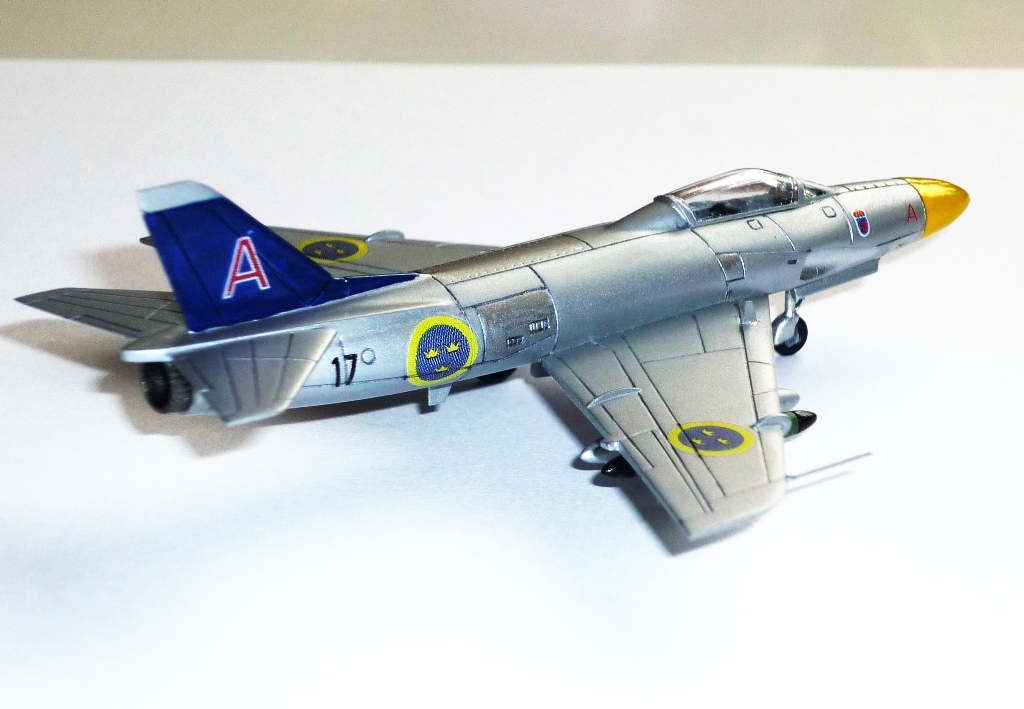
 SAAB 32 Lansen , looks particiluary sleek and exciting and would look good against the Hawker Hunter that also served with the Swedish. http://en.wikipedia.org/wiki/Saab_Lansen

This aircraft was designed to replace the old Turboprop aircraft in service with the Swedish airforce (Flygvapnet). Swedish Air Force requirements for the P1150 were demanding: the aircraft had to be able to attack anywhere along Sweden's 1,245 miles (2000 km) of coastline within one hour of launch from a central location. It had to be capable of being launched in any weather, day or night. Special attention was to be paid to integrating the electronics and weapons systems to create the equivalent of today's weapons systems approach to combat aircraft design. The aircraft was to be armed with four 20 mm cannons, rockets, bombs and/or a new anti-ship missile being developed, the Rb 04. The design team created a sleek airframe with clean lines powered by a license-built Rolls-Royce Avon Series 100

The AVRO CF-100 'Canuck', another great fighter from the Canadian stables before the American mega corporations squeezed the life from them. http://en.wikipedia.org/wiki/CF-100

In the early 1950s, Canada needed an all-weather interceptor (fighter) able to patrol the vast areas of Canada's north and operate in all weather conditions. The two-seat fighter crewed by a pilot and navigator, was designed with two powerful engines and an advanced radar and fire control system housed in its nose that enabled it to fly in all-weather or night conditions.Design of the XC-100 to meet a Royal Canadian Air Force (RCAF) specification for an all-weather fighter was initiated at Avro Canada in October 1946. Chief Engineer Edgar Atkin's work on the CF-100 was subsequently passed to John Frost formerly of de Havilland who, along with Avro's Chief Aerodynamacist Jim Chamberlin, reworked the original fuselage design.

de Havilland Canada DHC-2 Beaver, well a man can never have to much of a good thing...
An interesting choice given its military service, however it should mean some interesting decal options? http://en.wikipedia.org/wiki/De_Havilland_Canada_DHC-2_Beaver

The de Havilland Canada DHC-2 Beaver is a single-engined, high-wing, propeller-driven, STOL aircraft developed by de Havilland Canada, primarily known as a bush plane. It is used for cargo and passenger hauling, aerial application (crop dusting and aerial topdressing), and has been widely adopted by armed forces as a utility aircraft. The United States Army purchased several hundred; nine DHC-2s are still in service with the U.S. Air Force Auxiliary (Civil Air Patrol) for search and rescue. A Royal New Zealand Air Force Beaver supported Sir Edmund Hillary's expedition to the South Pole.