Showing posts with label Yak. Show all posts

Saturday, November 25, 2017

1/144 Yak-1 1941 Version - Brengun


1/144 Yak-1 1941 Version - Brengun
1x Plastic Injection kit

http://www.hauler.cz/e-shop/1-144-plastic-kits-32/yak-1-1941-1396

Photo Etched sold separately
http://www.hauler.cz/e-shop/1-144-accessories-19/yak-1-(brengum-kit)-1397


1/144 Yak-1 Winter version plastic kit (2 models in the box) - North Star Models


1/144 Yak-1 Winter version plastic kit (2 models in the box) North Star Models

- plastic kits of Yak-1 (2 models in the box)
- resin parts for skis and RO-82 launchers with RS-82 rockets
- 2 variants of transparent canopy
- photoetching plate.
- decal by Begemot company – 5 possible variants of marking


PRE-ORDER open until December 10, model will be shipped after December 10 2017

https://northstarmodels.com/product/1144-yak-1-winter-version-plastic-kit-2-models-in-the-box/


Saturday, July 15, 2017

1/144 Yakovlev UT-2 / UT-2M (2 in 1 Box) - Mikro-Mir (Mikr-Mir)


1/144 Yakovlev UT-2 (2 in 1 Box) - Mikro-Mir (Mikr-Mir)

The Yakovlev UT-2 (NATO reporting name "Mink") was a single-engine tandem two-seat low-wing monoplane that was the standard Soviet trainer during the Great Patriotic War. It was used by the Soviet Air Force from 1937 until replaced by the Yakovlev Yak-18 during the 1950s.
The preceding U-2 (Po-2) biplane was no longer a suitable trainer for the faster modern aircraft entering service, and to fill the role, the UT-2 was designed as a trainer.

The new aircraft was designed by Alexander Sergeevich Yakovlev's team at OKB-115. Originally designated AIR-10, it was based upon the AIR-9, but it was simpler, with tandem open cockpits, also omitting slats and flaps. It first flew on 11 July 1935. The AIR-10 won the competition in 1935 and, after minor changes, was accepted as the standard Soviet Air Force trainer.

The wood-and-metal mixed construction of the AIR-10 was simplified to use only wood to facilitate production, and the AIR-10s 120 hp Renault inline engine was replaced with the 112 kW (150 hp) Shvetsov M-11E radial on the prototype, and the 82 kW (110 hp) M-11Gs in early production aircraft. Serial production started in September 1937. The Soviet VVS (Air Force) assigned the aircraft the designation UT-2 (uchebno-trenirovochnyi, trainer).

The UT-2 was not easy to fly and easily entered into spins. The UT-2 model 1940 featured a lengthened forward fuselage, and a change to the 93 kW (125 hp) M-11D radial to attempt to rectify the problem. Despite improvements, the handling and flight characteristics remained challenging.
To further improve handling and stability, the new UT-2M (modernized) variant was developed in 1941 and it replaced the original UT-2 in production. The wing planform was redesigned, with a swept leading edge and a straight trailing edge, and the vertical stabilizer was enlarged.

7,243 UT-2 of all types were produced in five factories between 1937 and 1946. In the 1950s, the UT-2 was replaced by the Yak-18 primary trainer and the Yak-11 advanced trainer.

Before and after World War II the UT-2 was used by civilian organizations, and after the war, UT-2s were also operated by the Polish and Hungarian Air Forces.

http://www.mikro-mir.com/en/300.html

http://www.mikro-mir.com/images/phocagallery/Avia/avia-144/ut2/instr.pdf

https://en.wikipedia.org/wiki/Yakovlev_UT-2


Estimated Release: August 2017


Saturday, July 08, 2017

1/144 YAK-24 'Code name HORSE' - Eastern Express


1/144 YAK-24 'Code name HORSE' - Eastern Express

In late summer 1952, the Soviet Union issued two design specifications for helicopters, with the intent of catching up to the United States in post-World War II helicopter development. The design for the a medium size helicopter which could transport 12 people was issued to the Mil Design Bureau, whereas the design for a larger version capable transporting 24 people was given to the Yakovlev Design Bureau, which had not had any previous design experience with helicopters prior to this project.

The initial variant was the Yak-24 – Army transport helicopter, that could carry up to 30 airborne troops, 18 stretchers or 3,000 kg (6,614 lb) of cargo. From 1958, the improved model Yak-24U was produced, with all-metal rotors of larger diameter (21 m/69 ft) and an all-metal fuselage. It could carry 40 soldiers or 3,500 kg (7,716 lb) of cargo, including two GAZ-69 jeeps or anti-tank guns. A civilian variant for 30 passengers was the Yak-24A, produced from 1960 in small numbers. It was also used as a flying crane, lifting an external load of 5,000 kg (11,023 lb).

110 Plastic Parts, 3x Decal Schemes.

Available: Now

Source: https://modelsua.com/Yak-24-Horse-helicopter-1-144-Eastern-Express-14515.html


Monday, May 29, 2017

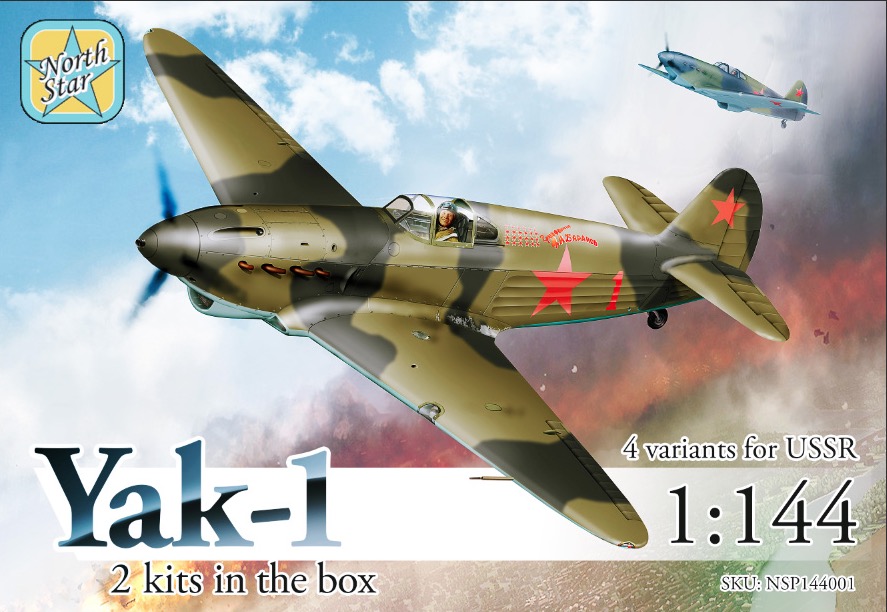
1/144 Yak-1 (2 kits in 1) from Northstar


1/144 Yak-1 (2 kits in 1) from Northstar
At this stage, I am not sure what decals etc will be available, but the box indicates 4 schemes. (to be confirmed)

The Yakovlev Yak-1 (Russian: Яковлев Як-1) was a World War II Soviet fighter aircraft. Production began in early 1940. It was a single-seat monoplane with a composite structure and wooden wings.

The Yak-1 was manoeuvrable, fast and well armed, and it was easy to maintain and reliable. It formed an excellent basis for subsequent developments from the Yakovlev bureau. It was the founder of a family of aircraft, with some 37,000 being built (Soviet naming conventions obscure the fact that the Yak-1 and its successors — the Yak-7, Yak-9 and Yak-3 — are essentially the same design)

https://en.wikipedia.org/wiki/Yakovlev_Yak-1

Expected release date : "soon" June-July 2017

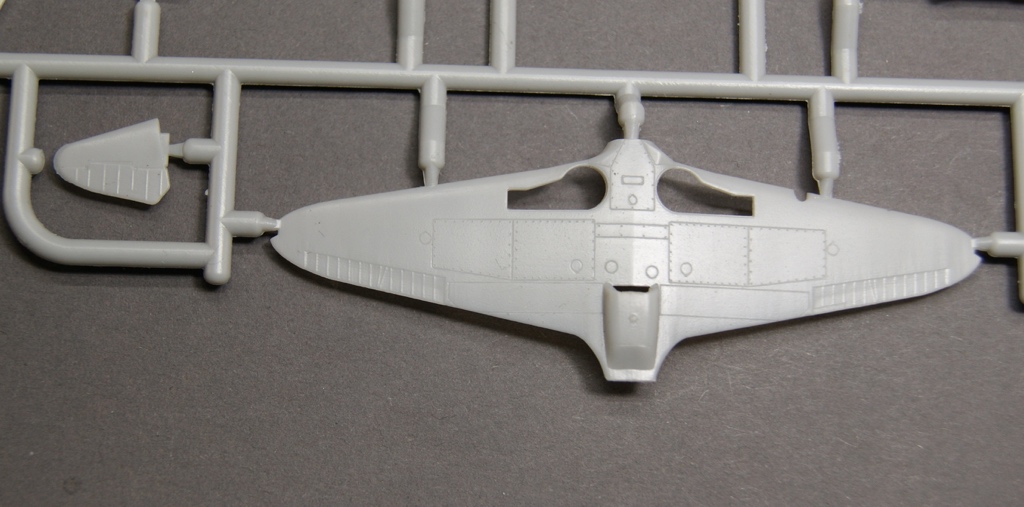
More sprue Shots from Nothstar
https://northstarmodels.com/2017/05/northstarmodels-1144-yak-1-test-sprues/