Showing posts with label Miniwings. Show all posts

Sunday, February 09, 2020

1/144 Percival PROVOST T.1 / T.53 British trainer - Miniwings


1/144 Percival PROVOST T.1 / T.53  British trainer - Miniwings

A nice little injected plastic key of a classic british trainer, up to the usual sminiwings standards. You will note some of the fine details on this release - of particular note is the quality of the canopy and how thin the glazing is for such a small piece in this scale!

Two kits are provided in this boxed edition

During the 1950s, the Provost was developed for the Royal Air Force (RAF) as a replacement for the Percival Prentice. The Provost was an all-metal, single-engined, two-seat monoplane, featuring fixed conventional landing gear with a fully-castering tailwheel. It was developed to provide training that was better-suited to the increasingly-complicated operational aircraft that were then being brought into service. The main two seats in the cockpit were positioned in a side-by-side configuration, enabling the instructor to sit directly alongside the student, easing training by allowing for mutual close observation and for flight procedures to be more readily demonstrated; a third seat had been originally specified for use by an observer, but this position was later omitted following little use.[6] The cockpit was considered to be relatively bulky amongst its contemporary rivals, a feature that did not heavily impinge upon the aircraft's overall performance.[3] The type was designed to be easy to maintain; various components were intentionally interchangeable where possible and there was a generous provision of access hatches in the fuselage.
https://en.wikipedia.org/wiki/Percival_Provost

Description for Ref. No.: mini331
2 kit - (Boxed)
23 Plastic parts - included are bonus underwing rockets intended for the Omani export version!
1 Clear plastic canopy
4 Decal versions
 - RAF Central Flying School
 - Sudanese Airforce
 - Irish Air Corps
 - Iraqi Air Force

http://www.miniwing.cz/percival-provost-t-1-t-53.html
Available: January 2020

Cost: 20.99 $ - inc Free Global Shipping from Kits-World
http://www.kits-shop.com/
http://www.kits-shop.com/miniwing-plastic-1-144.php

Review kit supplied by Miniwing


1/144 Percival PROVOST T.1 British trainer - Miniwings


 1/144 Percival PROVOST T.1 British trainer - Miniwings

A nice little injected plastic key of a classic british trainer, up to the usual sminiwings standards. You will note some of the fine details on this release - of particular note is the quality of the canopy and how thin the glazing is for such a small piece in this scale!

A single kit is provided in this bagged edition.

During the 1950s, the Provost was developed for the Royal Air Force (RAF) as a replacement for the Percival Prentice. The Provost was an all-metal, single-engined, two-seat monoplane, featuring fixed conventional landing gear with a fully-castering tailwheel. It was developed to provide training that was better-suited to the increasingly-complicated operational aircraft that were then being brought into service. The main two seats in the cockpit were positioned in a side-by-side configuration, enabling the instructor to sit directly alongside the student, easing training by allowing for mutual close observation and for flight procedures to be more readily demonstrated; a third seat had been originally specified for use by an observer, but this position was later omitted following little use.[6] The cockpit was considered to be relatively bulky amongst its contemporary rivals, a feature that did not heavily impinge upon the aircraft's overall performance.[3] The type was designed to be easy to maintain; various components were intentionally interchangeable where possible and there was a generous provision of access hatches in the fuselage.
https://en.wikipedia.org/wiki/Percival_Provost

Description for Ref. No.: mini333
1 kit - Budget edition (Bagged)
23 Plastic parts - included are bonus underwing rockets intended for the Omani export version!
1 Decal version
 -  RAF No.2 Flying Training School

http://www.miniwing.cz/percival-provost-t-1.html

Cost: 16.99 $ - inc Free Global Shipping from Kits-World

Review kit supplied by Miniwing


1/144 Percival PROVOST T.52 British trainer / light attack - Miniwings


1/144 Percival PROVOST T.52 British trainer / light attack - Miniwings

A nice little injected plastic key of a classic british trainer, up to the usual sminiwings standards. You will note some of the fine details on this release - of particular note is the quality of the canopy and how thin the glazing is for such a small piece in this scale!

A single kit is provided in this bagged edition

During the 1950s, the Provost was developed for the Royal Air Force (RAF) as a replacement for the Percival Prentice. The Provost was an all-metal, single-engined, two-seat monoplane, featuring fixed conventional landing gear with a fully-castering tailwheel. It was developed to provide training that was better-suited to the increasingly-complicated operational aircraft that were then being brought into service. The main two seats in the cockpit were positioned in a side-by-side configuration, enabling the instructor to sit directly alongside the student, easing training by allowing for mutual close observation and for flight procedures to be more readily demonstrated; a third seat had been originally specified for use by an observer, but this position was later omitted following little use.[6] The cockpit was considered to be relatively bulky amongst its contemporary rivals, a feature that did not heavily impinge upon the aircraft's overall performance.[3] The type was designed to be easy to maintain; various components were intentionally interchangeable where possible and there was a generous provision of access hatches in the fuselage.
https://en.wikipedia.org/wiki/Percival_Provost

Description for  Ref. No.: mini332
1 kit - Budget edition (Bagged)
23 Plastic parts - included are underwing rockets  for the attack configuration
1 Decal version
 - The Sultan of Omans's Air Force

http://www.miniwing.cz/percival-provost-t-52.html

Cost: 16.99 $ - inc Free Global Shipping from Kits-World
http://www.kits-shop.com/
http://www.kits-shop.com/miniwing-plastic-1-144.php

Wednesday, August 30, 2017

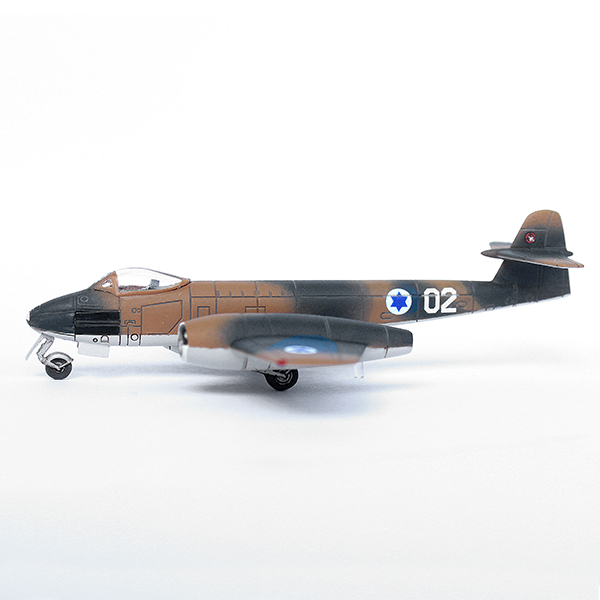
1/144 Gloster METEOR F Mk.8 - Miniwings


1/144 Gloster METEOR F Mk.8 - Miniwings
The Gloster Meteor was the first British jet fighter and the Allies' only jet aircraft to achieve combat operations during the Second World War. The Meteor's development was heavily reliant on its ground-breaking turbojet engines, pioneered by Sir Frank Whittle and his company, Power Jets Ltd. Development of the aircraft began in 1940, although work on the engines had been under way since 1936. The Meteor first flew in 1943 and commenced operations on 27 July 1944 with No. 616 Squadron RAF. Nicknamed the "Meatbox", the Meteor was not a sophisticated aircraft in its aerodynamics, but proved to be a successful combat fighter. Gloster's 1946 civil Meteor F.4 demonstrator G-AIDC was the first civilian-registered jet aircraft in the world.[1]

Several major variants of the Meteor incorporated technological advances during the 1940s and 1950s. Thousands of Meteors were built to fly with the RAF and other air forces and remained in use for several decades. The Meteor saw limited action in the Second World War. Meteors of the Royal Australian Air Force (RAAF) fought in the Korean War. Several other operators such as Argentina, Egypt and Israel flew Meteors in later regional conflicts. Specialised variants of the Meteor were developed for use in photographic aerial reconnaissance and as night fighters.

https://en.wikipedia.org/wiki/Gloster_Meteor

Description:
14 Resin parts
Clear resin and Vacu Canopy
Canopy Mask

Screen printed decals:
- IAF '02' 117 Tajeset 'Hasilon Harishona' Ramat David, 1960, and
- RAF WK803-V no 56 Squadron RAF Waterbeach 1953

http://www.miniwing.cz/gloster-meteor-tmk8.html

Available : Now

http://kits-shop.com/index.php (with free shipping)

also https://www.hannants.co.uk/product/MINI085

See also available : https://kampfgruppe144.blogspot.co.uk/2017/07/1144-gloster-meteor-tmk7-miniwing.html


Saturday, October 22, 2016

1/144 F-84G THUNDER JET / F-84F THUNDER STREAK - Miniwing


1/144 F-84G THUNDER JET  / F-84F THUNDER STREAK - Miniwing
Miniwing has released a brace of early US jets for your delight

The Republic F-84 Thunderjet was an American turbojet fighter-bomber aircraft. Originating as a 1944 United States Army Air Forces (USAAF) proposal for a "day fighter", the F-84 first flew in 1946. Although it entered service in 1947, the Thunderjet was plagued by so many structural and engine problems that a 1948 U.S. Air Force review declared it unable to execute any aspect of its intended mission and considered canceling the program. The aircraft was not considered fully operational until the 1949 F-84D model and the design matured only with the definitive F-84G introduced in 1951. In 1954, the straight-wing Thunderjet was joined by the swept-wing F-84F Thunderstreak fighter and RF-84F Thunderflash photo reconnaissance aircraft.

The Thunderjet became the USAF's primary strike aircraft during the Korean War, flying 86,408 sorties and destroying 60% of all ground targets in the war as well as eight Soviet-built MiG fighters. Over half of the 7,524 F-84s produced served with NATO nations, and it was the first aircraft to fly with the U.S. Air Force Thunderbirds demonstration team. The USAF Strategic Air Command had F-84 Thunderjets in service from 1948 through 1957.

The F-84 was the first production fighter aircraft to utilize inflight refueling and the first fighter capable of carrying a nuclear weapon, the Mark 7 nuclear bomb. Modified F-84s were used in several unusual projects, including the FICON and Tom-Tom dockings to the B-29 Superfortress and B-36 bomber motherships, and the experimental XF-84H Thunderscreech turboprop.

The F-84 nomenclature can be somewhat confusing. The straight-wing F-84A to F-84E and F-84G models were called the Thunderjet. The F-84F Thunderstreak and RF-84F Thunderflash were different airplanes with swept wings. The XF-84H Thunderscreech (not its official name) was an experimental turboprop version of the F-84F. The F-84F swept wing version was intended to be a small variation of the normal Thunderjet with only a few different parts, so it kept the basic F-84 number. Production delays on the F-84F resulted in another order of the straight-wing version; this was the F-84G.

In 1949, a swept wing version of the F-84 was created with the hope of bringing performance to the level of the F-86. The last production F-84E was fitted with a swept tail, a new wing with 38.5 degrees of leading edge sweep and 3.5 degrees of anhedral, and a J35-A-25 engine producing 5,300 pound-force (23.58 kN) of thrust.[1] The aircraft was designated XF-96A. It flew on 3 June 1950 with Otto P. Haas at the controls. Although the airplane was capable of 602 knots (693 mph, 1,115 km/h), the performance gain over the F-84E was considered minor.[1] Nonetheless, it was ordered into production in July 1950 as the F-84F Thunderstreak. The F-84 designation was retained because the fighter was expected to be a low-cost improvement of the straight-wing Thunderjet with over 55 percent commonality in tooling.[1]

Thunderbirds Display Team

Thunderbirds Display Team

USAF and Hellenic AF


You will find that these are presented in the same detail and quality of previous releases!

20 resin parts
clear resin canopy
vac-form canopy
screen printed decals
canopy mask

From: http://www.kits-shop.com/ or Usual Stockists


Saturday, March 28, 2015

1/144 Supermarine ATTACKER FB.2 - Miniwings


1/144 Supermarine ATTACKER FB.2 - Miniwings

The Supermarine Attacker was a British single-seat naval jet fighter built by Supermarine for the Royal Navy's Fleet Air Arm (FAA). The type has the distinction of being the first jet fighter to enter operational service with the FAA. Like most other first-generation jet fighter, it has a short service life due to the rapid development of increasingly advanced aircraft during the 1950s and 1960s.

The Attacker developed from a Royal Air Force (RAF) fighter jet project, under Air Ministry Specification E.10 of 1944 (the E for experimental). The design of the Attacker used the laminar flow straight-wings of the Supermarine Spiteful, a piston-engined fighter intended to replace the Supermarine Spitfire, and what became the Attacker was originally referred to as the "Jet Spiteful".

The FB 2  introduced a new Rolls-Royce Nene engine and modifications to its structure. The Supermarine Attacker now had eight underwing pylons which could carry two 1,000 lb (454 kg) bombs or eight unguided rockets.

http://en.wikipedia.org/wiki/Supermarine_Attacker

Description:
24 resin parts
1 clear resin canopy
1 vacu canopy for expected modellers
8 etched parts
Decals for :
800 Squadron FAA, HMS Eagle
Pakistan Airforce FB,2 R4003 (link)

Conforming to the Miniwing signature format, being cleanly cast with quality resin with no obvious air bubbles. The panel lines on fuselage  are very finely cast and provide a good balance between finesse and detailing


Available now with discount and free shipping from: http://kits-shop.com/index.php , and usual suppliers

Tuesday, December 30, 2014

1/144 Supermarine ATTACKER F.1 - Miniwings


1/144 Supermarine ATTACKER F.1 - Miniwings

The Supermarine Attacker was a British single-seat naval jet fighter built by Supermarine for the Royal Navy's Fleet Air Arm (FAA). The type has the distinction of being the first jet fighter to enter operational service with the FAA. Like most other first-generation jet fighter, it has a short service life due to the rapid development of increasingly advanced aircraft during the 1950s and 1960s.

he Attacker developed from a Royal Air Force (RAF) fighter jet project, under Air Ministry Specification E.10 of 1944 (the E for experimental). The design of the Attacker used the laminar flow straight-wings of the Supermarine Spiteful, a piston-engined fighter intended to replace the Supermarine Spitfire, and what became the Attacker was originally referred to as the "Jet Spiteful".

The project was intended to provide an interim fighter for the RAF while another aircraft, the Gloster E.1/44 also using the Nene was developed. An order for three prototypes was placed on 30 August 1944,the second and third of which were to be navalised. An order for a further 24 pre-production aircraft, six for the RAF and the remaining 18 for the Fleet Air Arm was placed on 7 July 1945.


Description:
24 resin parts
1 clear resin canopy
1 vacu canopy for expected modellers
8 etched parts
decals for two colors of FAA

onforming to the Miniwing signature format, being cleanly cast with quality resin with no obvious air bubbles. The panel lines on fuselage  are very finely cast and provide a good balance between finesse and detailing

Available now with discount and free shipping from: http://kits-shop.com/index.php , and usual suppliers

Friday, December 05, 2014

1/144 Fouga CM.170 "Magister" - Miniwings


1/144 Fouga CM.170 "Magister" - Miniwings

Originally designed for the French Air Fore (Armée de l'Air, AdA), and exported initially to Germany and then to many countries around the world, including locally licensed production. It has also been used as a light strike and fighter aircraft, while also seeing service with a number of acrobatic teams!
http://en.wikipedia.org/wiki/Fouga_CM.170_Magister

A great little and straightforward kit conforming to the Miniwing style being cleanly cast quality resin with no obvious air bubbles. The panel lines on fuselage  are very finely cast and provide a good balance between finesse and detailing

This kit also includes both Vac-Form and Clear Resin Canopy options and also has a photo-etched sprue for detailing.

It comes with Decals designed by JBR-Decals for two options:
Fouga Magister no.404 (10-KG) French Air force - 1971
Fouga Magister no.298 (219) Irish Air Corps - 1997

also available in Israeli and Belgian Schemes:
http://www.miniwing.cz/fouga-cm-170-magister-.html

availabe now with free shipping from Kits-Shop: http://kits-shop.com/aircraft.php

Sunday, August 17, 2014

1/144 FAM IA 58 "Pucara" - Miniwings


1/144 FAM IA 58 "Pucara" - Miniwings
The FMA IA 58 Pucará (Quechua: Fortress) is an Argentine ground-attack and counter-insurgency (COIN) aircraft manufactured by the Fábrica Militar de Aviones. It is a low-wing two-turboprop-engined all-metal monoplane with retractable landing gear, and is capable of operating from unprepared strips when operationally required. The type saw action during the Falklands War and the Sri Lankan Civil War.
[Source] http://en.wikipedia.org/wiki/FMA_IA_58_Pucar%C3%A1

A nice little kit of what should makeup to be a great looking kit, in the style of some of the older Miniwings kits and as such  this release should bring not great surprises. Out of the box its a nice looking kit and made up of a number of sprues of resin parts and a couple of canopies in either vac-form or clear resin based upon your preference. In addition are decals for two airframes from the more recent supplier JBR Decals who also produce a range of decals that are well worth looking at in their own right.

Of course, you could make a diorama with this kit after they have had their visit from 'the boys from Hereford', though it deserves to be built intact :-)

Available now with free global shipping from Kits-World!
http://kits-shop.com/aircraft.php

See also KG144BBS