Showing posts with label Mikro-Mir. Show all posts

Friday, January 21, 2022

1/144 Myasischev VM-T Atlant - Mikro-Mir


1/144 Myasischev VM-T Atlant - Mikro-Mir

The first Mikr-Mir release of 2022.
Myasischev VM-T Atlant with 2x payload options.
Available: January 2022.
Price:  Currently ~£56 + shipping on EBAY (it should become available via your usual supplier)


Wednesday, June 23, 2021


1/144 US SEALION Combatant Craft Heavy (CCH) (Plastic model)- Mikr Mir

( This is a machine translation. Please allow for possible misinterpretations in the text. )

-Sea Lion (Sea Air Land Insertion, Observation and Neutralization) is a stealth boat for Navy SEALs developed in the United States.

-Inside, it can carry two Shields units and two Combat Rubber Raiding Crafts (combat assault reconnaissance boats), and is equipped with a radar and a forward-looking infrared device.

――This ship can also be transported by the stern hangar of the amphibious assault ship and the C-5 / C-17 transport aircraft.

――During the operation, most of the hull is submerged and sailed to improve stealth, but when ascending, ballast water is drained from the ballast tanks installed on the left and right sides of the hull and ascended.

--This injection plastic kit comes with a painted mask sticker and a stand.

――When completed, the total length will be about 150 mm.

--Completely new mold

( This is a machine translation. Please allow for possible misinterpretations in the text. )

http://www.hisutton.com/SEALION%20and%20Alligator%20stealth%20boats.html


Manufacturer : Mikro Mir
Scale : 1/144
Release Date : Aug(Jun. 22, 2021 Pre-order start.)
List Price         : 4,510yen about 40.89USD
Sales Price : 3,485yen about 31.6USD

https://www.1999.co.jp/eng/10793874


Wednesday, November 25, 2020

1/144 Zeppelin LZ-13 HANSA- by Mikr-Mir


 1/144 Zeppelin LZ-13 HANSA- by Mikr-Mir

The Zeppelin LZ 13 Hansa (or simply Hansa) was a German civilian rigid airship first flown in 1912. It was built for DELAG to carry passengers and post and flew the first international passenger flight, visiting Denmark and Sweden in September 1912.[1] In 1913 it was hired to the Imperial German Navy as a training craft, and at the outbreak of World War I it was requisitioned by the German military who used it for bombing, reconnaissance, and finally as a training airship.

Future Release

https://www.facebook.com/mikro.mir.dnepr/

@100CM long!


Sunday, June 02, 2019

Sunday, February 25, 2018

1/144 'Peral' Spanish Submarine 1888- Mikro-Mir


1/144 'Peral' Spanish Submarine 1888- Mikro-Mir

'Peral' The worlds first electric powered submarine. Built by the Spanish engineer and sailor Isaac Peral for the Spanish Navy. Launched 8 September 1888

https://www.hannants.co.uk/product/MM144-021

https://www.facebook.com/mikro.mir.dnepr/photos/a.1416729748404757.1073741828.1416295571781508/1793227350754993/?type=3&theater

Peral was the first electric battery-powered submarine, built by the Spanish engineer and sailor Isaac Peral for the Spanish Navy.[1] The first fully capable military submarine,[2] she was launched 8 September 1888. She had one torpedo tube (and two torpedoes) and an air regeneration system. Her hull shape, propeller, and cruciform external controls anticipated later designs.[citation needed] Her underwater speed was 3 kn (5.6 km/h; 3.5 mph). With fully charged batteries, she was the fastest submarine yet built, with underwater performance levels (except for range) that matched those of First World War U-boats for a very short period, before her batteries began to drain. For example, the SM U-9, a pre-war German U-boat built in 1908, had an underwater speed of 8.1kn, and an underwater range of 150 km (81 nmi) at 5.8kn, before having to resurface to recharge her batteries.[citation needed] In June 1890, Peral's submarine launched a torpedo while submerged. It was also the first submarine to incorporate a fully reliable underwater navigation system. However, conservatives in the Spanish naval hierarchy terminated the project despite two years of successful tests. Her operational abilities have led some to call her the first U-boat.[3]

Peral was withdrawn from service in 1890 and is now preserved at the Cartagena Naval Museum.
https://en.wikipedia.org/wiki/Peral_Submarine


Saturday, July 15, 2017

1/144 Yakovlev UT-2 / UT-2M (2 in 1 Box) - Mikro-Mir (Mikr-Mir)


1/144 Yakovlev UT-2 (2 in 1 Box) - Mikro-Mir (Mikr-Mir)

The Yakovlev UT-2 (NATO reporting name "Mink") was a single-engine tandem two-seat low-wing monoplane that was the standard Soviet trainer during the Great Patriotic War. It was used by the Soviet Air Force from 1937 until replaced by the Yakovlev Yak-18 during the 1950s.
The preceding U-2 (Po-2) biplane was no longer a suitable trainer for the faster modern aircraft entering service, and to fill the role, the UT-2 was designed as a trainer.

The new aircraft was designed by Alexander Sergeevich Yakovlev's team at OKB-115. Originally designated AIR-10, it was based upon the AIR-9, but it was simpler, with tandem open cockpits, also omitting slats and flaps. It first flew on 11 July 1935. The AIR-10 won the competition in 1935 and, after minor changes, was accepted as the standard Soviet Air Force trainer.

The wood-and-metal mixed construction of the AIR-10 was simplified to use only wood to facilitate production, and the AIR-10s 120 hp Renault inline engine was replaced with the 112 kW (150 hp) Shvetsov M-11E radial on the prototype, and the 82 kW (110 hp) M-11Gs in early production aircraft. Serial production started in September 1937. The Soviet VVS (Air Force) assigned the aircraft the designation UT-2 (uchebno-trenirovochnyi, trainer).

The UT-2 was not easy to fly and easily entered into spins. The UT-2 model 1940 featured a lengthened forward fuselage, and a change to the 93 kW (125 hp) M-11D radial to attempt to rectify the problem. Despite improvements, the handling and flight characteristics remained challenging.
To further improve handling and stability, the new UT-2M (modernized) variant was developed in 1941 and it replaced the original UT-2 in production. The wing planform was redesigned, with a swept leading edge and a straight trailing edge, and the vertical stabilizer was enlarged.

7,243 UT-2 of all types were produced in five factories between 1937 and 1946. In the 1950s, the UT-2 was replaced by the Yak-18 primary trainer and the Yak-11 advanced trainer.

Before and after World War II the UT-2 was used by civilian organizations, and after the war, UT-2s were also operated by the Polish and Hungarian Air Forces.

http://www.mikro-mir.com/en/300.html

http://www.mikro-mir.com/images/phocagallery/Avia/avia-144/ut2/instr.pdf

https://en.wikipedia.org/wiki/Yakovlev_UT-2


Estimated Release: August 2017


Saturday, April 01, 2017

1/144 German Type UB 1 Submarine -- Mikro-Mir (Mikr-Mir)


1/144 German Type UB 1 Submarine -- Mikro-Mir (Mikr-Mir)
Plastic injected kit, with decals and photo-etched parts.

The Type UB I was a class of small coastal submarines (U-boats) built in Germany at the beginning of the First World War. 20 boats were constructed, most of which went into service with the German Imperial Navy.[Note 1] Boats of this design were also operated by the Austro-Hungarian Navy (Kaiserliche und Königliche Kriegsmarine or K.u.K. Kriegsmarine) and the Bulgarian Navy. The group is sometimes known as the UB-1 class after SM UB-1, the class leader. In the Austro-Hungarian Navy, it was called the U-10 class.

https://en.wikipedia.org/wiki/German_Type_UB_I_submarine

https://www.hannants.co.uk/product/MM144-016


For details of the sprues, decals and photo-etching please see:
http://mikro-mir.com/en/279.html

Price: ~$20USD


Thursday, April 14, 2016

1/144 "Resurgam" British Submarine - Mikro-Mir


1/144 "Resurgam"  British Submarine - Mikro-Mir
Clearly, someone at Mikro-Mir is a big fan of early and unusual British Submarines!
Here we have an early one from the 19th Century.
https://en.wikipedia.org/wiki/Resurgam

Source:
https://www.hannants.co.uk/product/MM144-012
http://www.britmodeller.com/forums/index.php?/topic/234999722-victorian-submarines-resurgam-1144/

interestingly, in two colour schemes 'historical' and 'bright yellow!??' this has been released in 1/144 before, as part of Takara's Ships of the World Vol.2

http://images.delcampe.com/img_large/auction/000/156/728/838_001.jpg

Friday, March 25, 2016

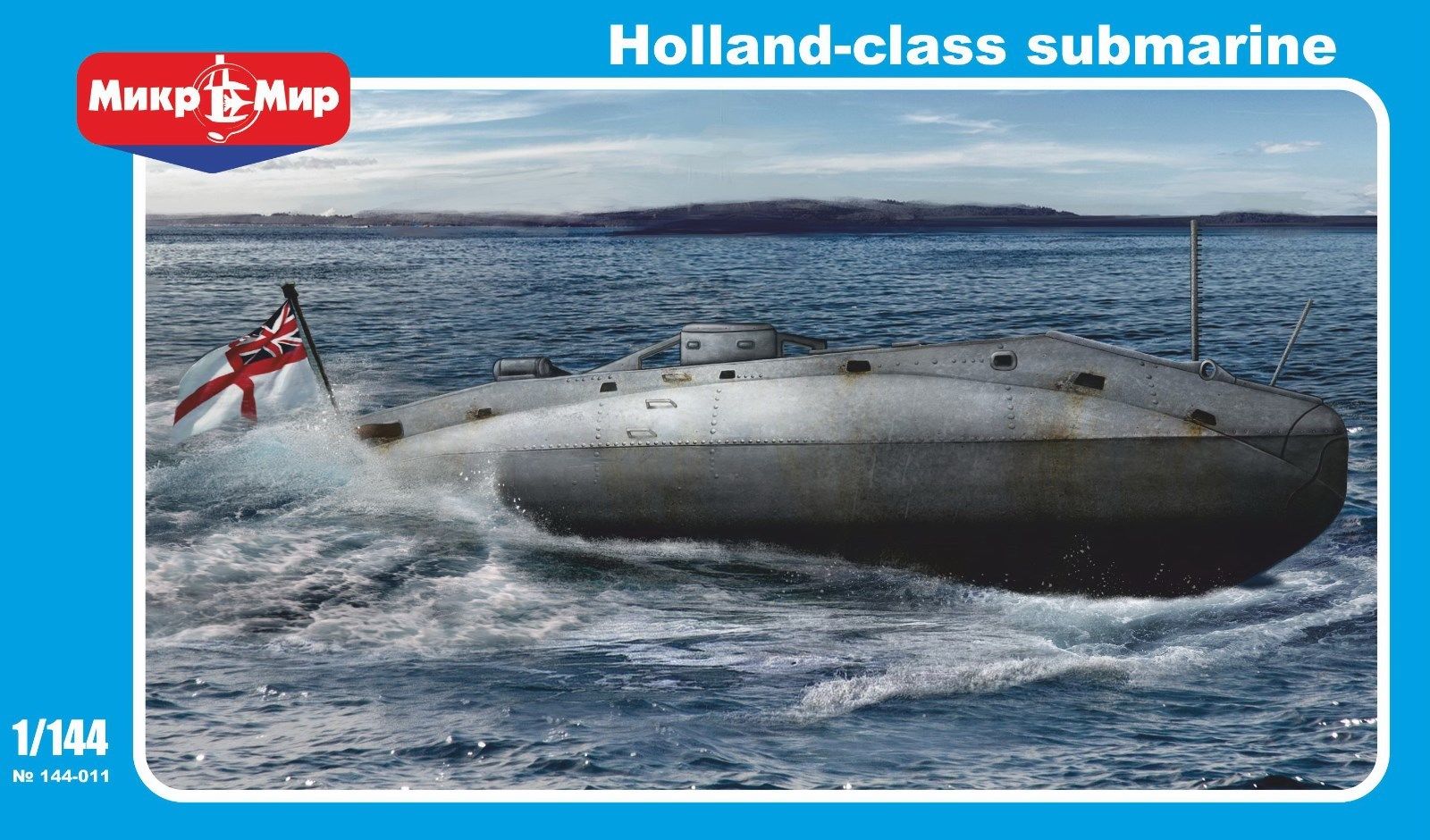
1/144 HMS Holland (class) submarine - MIKRO-MIR


1/44 HMS Holland (class) submarine - MIKRO-MIR
Another in their range of 1/144 submarines, this time an boat from the early days of the evolution of modern submarines.

Expect this to be injected plastic with a photo etched parts.

https://en.wikipedia.org/wiki/HMS_Holland_1


Its not on the website http://mikro-mir.com/en/ships-1-144.html , but it is appearing on ebay already!

Saturday, January 23, 2016

1/144 "Delfin" - Russian Imperial Submarine - MIKRO-Mir


1/144 "Delfin" - Russian Imperial Submarine - MIKRO-Mir

I don't know too much about this one at the moment, but it will typically be plastic with some photoetch parts?

https://www.hannants.co.uk/product/MM144-010

Available January 2015, currently @$20 on E-Bay.

Delfin (Дельфин, Russian: "Dolphin") was the first combat-capable Russian submarine. She was commissioned in 1903 and decommissioned in 1917, having served during World War I.

Delfin was designed by Naval architect Senior Assistant Ivan Grigoryevich Bubnov, Lieutenant M.N. Beklemishev and Lieutenant I.S. Goryunov of the Construction Commission for Submarines (later the Rubin Design Bureau). The design was of a single-hull type submarine with saddle tanks whose outer plating was covered with teak to prevent damage in the case of grounding.[1] She was ordered in July 1901[1] laid down by Baltic Works at St. Petersburg, launched in 1902, and entered service in 1903, training officers and sailors. Initially the vessel was classed as a torpedo boat and only given a number instead of a name.[1]

https://en.wikipedia.org/wiki/Russian_submarine_Delfin


Sunday, November 08, 2015

1/144 YAK-23 "FLORA" - MIKR-MIR (MICRO-MIR)


1/144 YAK-23 "FLORA" - MIKR-MIR (MICRO-MIR)
The Yakovlev Yak-23 (in Russian Як-23, USAF/DoD reporting name "Type 28"),[1] NATO reporting name "Flora"[2][3] was a jet fighter developed in the USSR in the 1940s and used in the early 1950s. The Yak-23 was developed as a simple lightweight jet fighter, on Yakovlev's own initiative. It was a development of the earlier Yak-15 and Yak-17 fighters, retaining their non-conventional layout with a jet engine in the fuselage nose and exhaust under the cockpit, but the construction was all new. Its wings were derived from the Yak-19. The Yak-23 used a Soviet copy of the British Rolls-Royce Derwent V turbojet engine, produced as the Klimov RD-500. It first flew on July 8, 1947.
https://en.wikipedia.org/wiki/Yakovlev_Yak-23

For more information, please see the following links
http://www.britmodeller.com/forums/index.php?/topic/234990141-yakovlev-yak-23-yak-23-nato-name-flora-1144/

http://www.greenmats.club/topic/967-%D0%B0%D0%B2%D0%B8%D0%B0%D1%86%D0%B8%D1%8F/#comment-10052

Expected "End of 2015"

(note: the image on the pack is of the 1/48 version)

Tuesday, August 04, 2015

1/144 Blackburn Beverley - Mikro-Mir (Mikr-Mir)


1/144 Blackburn Beverly - Mikro-Mir (Mikr-Mir)
Another interesting left field kit from Mikr-Mir, of a much under represented but instrumental British Transport Aircraft.

See the kit develop on the  Brit Modeller forum postings:
http://www.britmodeller.com/forums/index.php?/topic/234973041-blackburn-beverley-1144/

The Blackburn B-101 Beverley was a 1950s British heavy transport aircraft built by Blackburn and General Aircraft and flown by squadrons of Royal Air Force Transport Command from 1957 until 1967.

The aircraft was a high-wing cantilever monoplane with a fixed undercarriage. The large fuselage had a tail boom fitted with a tailplane with twin fins. The tail boom allowed access to the rear of the fuselage through removable clamshell doors. A 36 ft (11 m) main fuselage space was supplemented by passenger accommodation in the tail boom. The main cargo hold could accommodate 94 troops, with another 36 in the tail boom. In operation, it was regarded as "ungainly but highly effective" and was described by Air Chief Marshal Sir Robert Freer as "like something out of the Ark, but it was a superb supply dropper.”

Te aircraft was designed for carrying large bulk loads and landing them on rough or imperfect runways, or mere dirt strips. It could trace its design back to the GAL49 Hamilcar glider of the Second World War. When it entered service it was the largest aircraft in the Royal Air Force (RAF). It had a large interior cargo area split into two levels which amounted to around 6,003 ft³ (170 m³) of space. Paratroopers in the upper passenger area jumped through a hatch in the base of the boom just in front of the leading edge of the tailplane. Paratroopers in the main body exited through side doors.

The Beverley was equipped with toilets, which were situated in the tail beyond the paratroop hatch located on the floor of the tail boom. One fatality was caused by a serviceman who fell twenty feet to the ground when exiting the toilet, unaware that the paratroop hatch had been opened. Modifications were made to prevent the toilet doors from being opened when the paratroop hatch was open.[3]

In total, 49 of the aircraft were produced, with the last one being manufactured in 1958, and final retirement from RAF service was in 1967.

https://en.wikipedia.org/wiki/Blackburn_Beverley

An interesting article from 1948, Universal Transport" a 1948 Flight article on the GAL Universal Freighter (later renamed the Beverly):
http://www.flightglobal.com/pdfarchive/view/1948/1948%20-%200174.html
http://www.flightglobal.com/pdfarchive/view/1948/1948%20-%200175.html
http://www.flightglobal.com/pdfarchive/view/1948/1948%20-%200176.html
http://www.flightglobal.com/pdfarchive/view/1948/1948%20-%200177.html
http://www.flightglobal.com/pdfarchive/view/1948/1948%20-%200178.html

Tuesday, May 26, 2015

1/144 Royal Navy Submarine HMS Meteorite - MICRO MIR


1/144 Royal Navy Submarine HMS Meteorite

Mikro-mir are continuing to expand their eclectic mix of 1/144 kits, this time with some unusual submarines!
http://en.wikipedia.org/wiki/HMS_Meteorite
http://en.wikipedia.org/wiki/German_Type_XVII_submarine

See site for sprues, decals (also has photo etch, not shown_ and interestingly an conning tower not used on this kit..)
http://mikro-mir.com/en/182.html

The German Type XVII U-boats were small coastal submarines which used Hellmuth Walter's high test peroxide propulsion system, which offered a combination of air-independent propulsion and high submerged speeds.

In the early 1930s Hellmuth Walter had designed a small, high-speed submarine with a streamlined form propelled by high test peroxide and in 1939 he was awarded a contract to build an experimental vessel, the 80 ton V-80, which achieved an underwater speed of 28.1 kn (52.0 km/h; 32.3 mph) during trials in 1940. In November 1940 Admirals Erich Raeder and Werner Fuchs (head of the Kriegsmarine?'?s Construction Office) witnessed a demonstration of the V-80; Raeder was impressed, but Fuchs was slow to approve further tests.

Following the success of the V-80's trials, Walter contacted Karl Donitz in January 1942, who enthusiastically embraced the idea and requested that these submarines be developed as quickly as possible. An initial order was placed in summer 1942 for four Type XVIIA development submarines. Of these, U-792 and U-793, designated Wa 201, were built by Blohm & Voss, commissioned in October 1943, and achieved 20.25 kn (37.50 km/h; 23.30 mph) submerged. The other pair of Type XVIIA submarines, U-794 and U-795, designated Wk 202, were constructed by Germaniawerft and commissioned in April 1944.

The U-793 achieved a submerged speed of 22 kn (41 km/h; 25 mph) in March 1944 with Admiral Donitz aboard. In June 1944 the U-792 achieved 25 kn (46 km/h; 29 mph) over a measured mile. Construction of operational Type XVII submarines - the Type XVIIB - was begun at the Blohm & Voss yard in Hamburg. The Type XVIIB, unlike the XVIIA, had only a single turbine. The initial order was for 12 submarines, U-1405 through U-1416. However, Blohm & Voss were already struggling to cope with orders for Type XXI submarines and the Kriegsmarine reduced the order to six.Three Type XVIIB boats were completed by Blohm & Voss of Hamburg between 1943 and 1944: U-1405, U-1406 and U-1407. U-1405 was completed in December 1944, U-1406 in February 1945, and U-1407 in March 1945.

A further three boats (U-1408 to U-1410) were under construction, but were not complete when the war ended. Another six Type XVIIB's (U-1411 to U-1416) were cancelled during the war in favour of the Type XXI.All three completed Type XVIIB boats were scuttled by their crews at the end of the Second World War, U-1405 at Flensburg, and U-1406 and U-1407 at Cuxhaven, all in the British Zone of Occupation.
U-1407 was salvaged in June 1945, and transported to Barrow-in-Furness, where she was refitted by Vickers with a new and complete set of machinery also captured in Germany, under the supervision of Professor Hellmuth Walter. Because she was intended to be used solely for trials and possibly as a high-speed anti-submarine target, her torpedo tubes were removed.[3] She was commissioned into the Royal Navy on 25 September 1945 and renamed HMS Meteorite.

During 1946 Meteorite carried out a series of trials under the guidance of Walter and his original team from Germaniawerft, Kiel. The trials raised considerable interest in the possibility of HTP as an alternative to nuclear power as air-independent propulsion and the Admiralty placed an order for two larger experimental Walter boats based on the German Type XXVI, HMS Explorer and HMS Excalibur, to be followed by an operational class of 12 boats.

1/144 SOVIET WWII SUBMARINE CLASS SHCH SERIES V by MICRO-MIR


1/144 SOVIET WWII SUBMARINE CLASS 'SHCH SERIES V'  by MICRO-MIR 

See site for sprues, decals and photo etched fret.
http://mikro-mir.com/en/169.html

At the end of 1931 the Soviet government had decided to build for the Far East 12 submarines of the "Shch"  A series of submarines called - V series. The boat was a slightly modernized III-th series. Because of this basic technical elements submarines V series were the same as in boats III. The changes affected only the internal arrangement.

Submarines V series built at the Leningrad plant and finishing work in Vladivostok and Khabarovsk, where these boats were delivered by rail sections. Hull sections had joints, pre-prepared for subsequent riveting on-site assembly. Transportation sections was carried out on special rail transporters.

The first echelon with the sections of the first submarine V series built by Baltic plant was sent to the Far East June 1, 1932, t. E. In 5 months after the government's decision. During June-October 1932 all three plants were sent to the Far East all boats V series. Participation in hostilities, these boats are not accepted, but serve as a sufficient deterrent to the Soviet Far East

Saturday, October 25, 2014

1-144 Yakovlev Yak-11 (NATO reporting name: "Moose") - Mikro-Mir


1-144 Yakovlev Yak-11 (NATO reporting name: "Moose") - Mikro-Mir

Mikro-Mir are continuing their support of 1/144 and are previously indicated in their catalog are due for release (lets hope those Yak-23 and the Yak-36 are not far behind), its not clear yet whether these will be single kits, or follow the tradition of multiple kits per box? The kits are injected plastic, though better than your typical resin kit are not quite there up with revell etc, though should still make a nice kit. There is a great array of decals with this kit that allows you to produce a host schemes for Soviet,Czech, GDR, Syria  and Algeria.

The Yakovlev Yak-11 (NATO reporting name: "Moose", Russian: Як-11) was a trainer aircraft used by the Soviet Air Force and other Soviet-influenced air forces from 1947 until 1962.
http://en.wikipedia.org/wiki/Yakovlev_Yak-11

The Yakovlev design bureau began work on an advanced trainer based on the successful Yak-3 fighter in mid 1944, although the trainer was of low priority owing to the ongoing Second World War.[1] The first prototype of the new trainer, designated Yak-UTI or Yak-3UTI flew in late 1945. It was based on the radial-powered Yak-3U, but with the new Shvetsov ASh-21 seven-cylinder radial replacing the ASh-82 of the Yak-3U. It used the same all-metal wings as the Yak-3U, with a fuselage of mixed metal and wood construction. Pilot and observer sat in tandem under a long canopy with separate sliding hoods. A single synchronised UBS 12.7 mm machine gun and wing racks for two 100 kg (220 lb) bombs comprised the aircraft's armament.

An improved prototype flew in 1946, with revised cockpits and a modified engine installation with the engine mounted on shock absorbing mounts. This aircraft successfully passed state testing in October 1946, with production beginning at factories in Saratov and Leningrad in 1947. Production Yak-11s were heavier than the prototypes, with later batches fitted with non-retractable tail wheels and revised propellers. A 7.62 mm ShKAS machine gun was sometimes fitted instead of the UBS, while some were fitted with rear-view periscopes above the windscreen. In total, Soviet production amounted to 3,859 aircraft between 1947 and 1955. with a further 707 licence-built by Let in Czechoslovakia as the C-11.
The Yak-11 set five world-class records.

Source:
http://mikro-mir.com/en/103-yak-11

Monday, July 28, 2014

1/144 Vickers Valiant MK.I - Mikro-Mir


1/144 Vickers Valiant MK.I - Mikro-Mir

Having previously provided a 1/144 Project 865 Piranha Soviet Prototype Submarine and a 1/144 YAK UT-1 (pack of 3), Mikro-Mir look set to produce another classic V-bomber. If this kits follows the trend of thier other items it should largely be a resin based kit with possobily some photo etching, previous decals have not been that great (so let see if these improve on them).

http://kampfgruppe144.blogspot.co.uk/2009/02/1144-valiant-kits-review-by-david.html

https://www.blogger.com/blogger.g?blogID=20128243#editor/target=post;postID=454415732069805317